

January 2026
A month ago this column considered whether the 2025 could have been the pivotal year when the global power balance switched from the United States to China. Since then and almost on a daily basis global events have reinforced the rupture of the post-WW2 international order and highlighted risks in geopolitics. Perhaps the simplest numerical illustration is the price of gold. One ounce of gold started the year at less than 4,400 USD, towards the end of January it had rallied to 5,600 USD before falling back to 4,900 USD.
The line “there are decades where nothing happens; and there are weeks where decades happen”, is often attributed to Lenin although he likely never said it, but it captures perfectly the whirlwind of events of the past month. The sheer flood of news, threats and outrage, almost all due to President Trump can seem overwhelming but it is important to try and capture the full range of what is happening because they are often linked or serve as distractions from other more important topics.
The kidnapping of the sitting President of Venezuela, Nicolas Maduro, highlighted the brilliant competence of US military power. No doubt Putin would wish he could have been as successful four years ago when he tried to capture the Ukrainian president. That was then followed by oil tanker sanctions in the high seas showed the global reach of US force.
Protests in Iran which Trump encouraged with promises of help resulted in thousands shot dead by the Iranian regime yet with no intervention by Trump although that may still come as he sends a large military force to the region.
Trump’s claim that Greenland is essential to the national security of the United States and that only sovereign control of the country would satisfy his demand is an explicit threat and a territorial demand against treaty ally Denmark.
The World Economic Forum at Davos saw an unhinged rant from Trump attacking his allies and his establishment of his personal United Nations proxy, The Board of Peace. An oddly assorted collection of states who have to pay one billion USD to maintain membership which is chaired by Trump, not as President of the United States, but as Donald Trump the individual with sole veto power. Davos also saw a rebuke to the Trumpian disorder from Canadian Prime Minister Mark Carney, that will be discussed later.
Domestically Trump’s immigration policies have resulted in the killing of two American citizens followed by brazen lies and slanders from the administration when clear video footages shows the opposite.
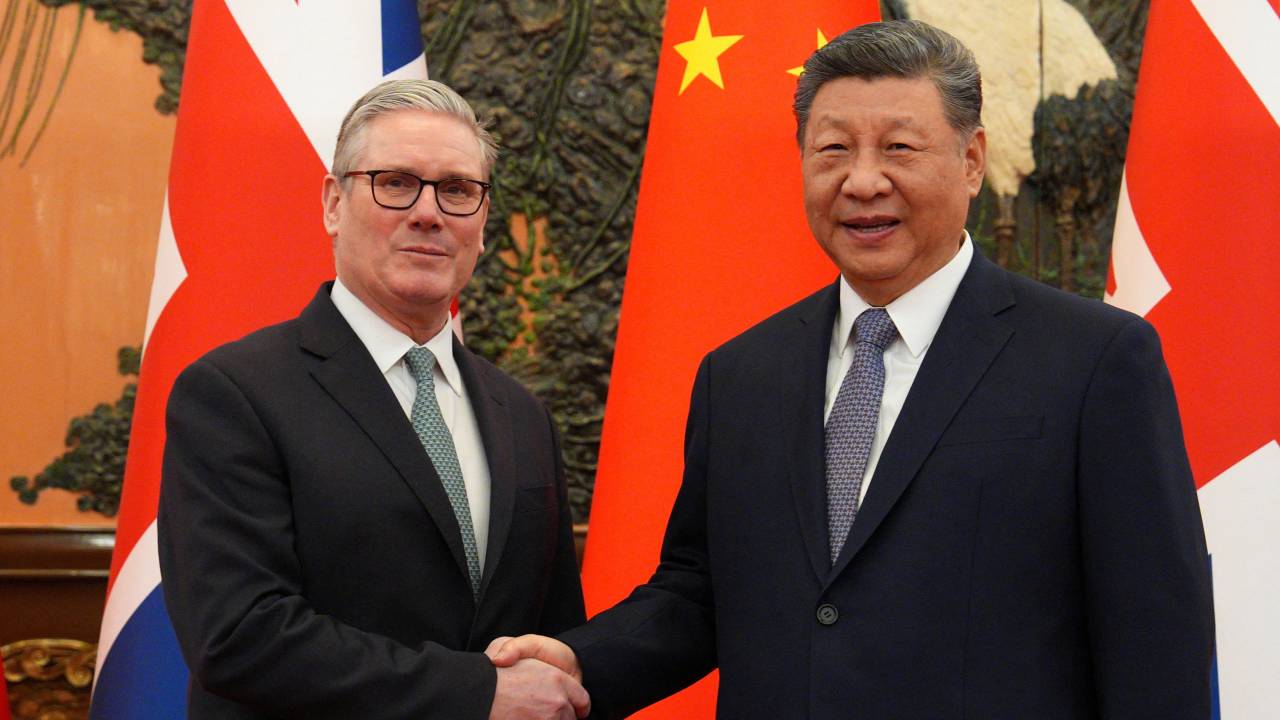
Beijing in winter continues to host various leaders looking to better diplomatic and economic ties with China. Mark Carney visited before Davos and Keir Starmer has just finished as visit before he visits Japan. Germany’s Frederich Merz is due in China in the second half of February.
For Xi it remains business as usual with his never-ending anti-corruption campaign. Since taking office some 13 years ago around 6 million people have been caught up in it. January saw yet another purge of PLA generals. The China Military Commission the top military body had eleven members when Xi took charge, it was cut down to 7 in 2021 and now only two remain as Xi cut long time friend ally (or so it was understood) Zhang Youxia and Liu Zhenli.
Just as the month was closing the Panamanian Supreme Court, in an unappealable decision, ruled that CK Hutchison’s control of the two Panama Canal ports was unconstitutional. It will be remembered that Trump threatened to invade Panama and seize the canal if the Chinese company didn’t sell out control. A US-led deal to replace Hutchison has now been thrown into limbo.
This list is far from exhaustive and almost every topic opens a pandora’s box of problems and decision trees of what comes next. How is one to make sense of what is going on? Some may argue that Trump is playing some sort of highly sophisticated 3-D or 4-D chess yet the reality is far more mundane and concerning. US policy has become like a reality TV show with every day or week being like a new episode. A cliff-hanger for the audience with the star Donald Trump always coming out as the center of attention. For those who cherry pick the bits of the Trump theatre they like or approve of such as the tough words to force Nato countries to contribute more to their defence they ignore the deep damage and loss of trust which such unilateral US action has already made. Few in Europe will place as much trust in the US as they did before Trump’s second term. Trump dismissal of the European militaries’ deaths in Afghanistan and Iraq will not be forgotten or forgiven.
Nor can supporting the removal of Maduro, a truly dreadful leader who has run his country into the ground, justify the grift and corruption at the heart of almost everything Trump does. Whether that is holding Venezuela oil money in offshore accounts controlled by the President or by the lawsuits the Trump family have brought against the US government demanding billions in compensation. All these events are part of the Trump reality show which the Presidency has descended into.
The Carney Response
Carney’s election victory last year was a direct result of his strong pushback against Trump and the threats to invade Canada. He has been an eloquent and informed voice of reason in defence of his country and for many others who are looking for a response to the Trumpian chaos that has been unleashed. Trump ranted for 70 minutes but it was Carney’s short 15-minute speech which deserves attention. He clearly encapsulates the problem which middle powers now face:
But I’d also say that great powers, great powers can afford for now to go it alone. They have the market size, the military capacity and the leverage to dictate terms. Middle powers do not.
But when we only negotiate bilaterally with a hegemon, we negotiate from weakness. We accept what’s offered. We compete with each other to be the most accommodating.
This is not sovereignty. It’s the performance of sovereignty while accepting subordination. In a world of great power rivalry, the countries in between have a choice – compete with each other for favour, or to combine to create a third path with impact.
Carney of course is referring to the United States and China when he talks of great powers going it alone, but Russia need also be included not for any economic might but for its military aggression and willingness to sacrifice millions of its own population to injure and death in pursuit of territorial conquest.
Carney asked the questions that many middle powers should be asking themselves. Whether it be the UK, Japan, South Korea, Brazil, Australia and the 27 members of the EU. How does a country navigate this new geopolitical environment without just become subject to the whims of either America or China?
A week before his Davos speech Carney had been in Beijing repairing diplomatic ties which had been in the cold since 2017. China had held hostage two Canadian citizens in response to Canada detention of Meng Wanzhou at the request of the US government. It has also become clear that China had been actively interfering in Canadian politics for decades so Carney knows that relations with China are far from straightforward. Despite that he boldly called for a new strategic relationship with China although the actual trade deals which he agreed with China are still relatively limited.
Over 60% of Canadian trade is with the United States. It is the best of neighbours who have fought and died for American interests for decades yet this have not insulted them from the scorn, ridicule and tariff actions of America. Carney’s aim to reach out and work with other middle powers is the correct approach. As unworkable as decoupling was from China, it is even more unworkable to think about decoupling from America. The role of the US dollar and the vibrancy and innovation of American business drives the global economy but the US has become an unreliable ally and economy partner and change will inevitably come.
A concrete example of Carney reaching out to the EU is the fact that Canada has become the first non-EU country to joint SAFE (Security Action for Europe) programme. This programme to help build up and fund EU defence industries is a response to the wavering commitment of the US to NATO and Canada was able to agree terms even though the UK had failed to do so. The EU in the past month has signed the EU-Mercosur agreement lowering tariffs on four countries, Argentina, Brazil, Paraguay and Uruguay, and separately agreed what they called “a mother of all trade deals” with India.
Carney was one of many leaders to make a trip to Beijing. Following Davos UK Prime Minister Starmer headed for China and Japan. His results were pretty thin on the ground but like Canada no leader had visited China 8 years. Starmer has struggled with almost all aspects of policy both domestically and internationally and his China policy is no different. He still believes there are big economic wins although the history of Sino-British relations proves that Chinese economic riches remain elusive. He won a reduction in whisky import taxes, a promise to provide visa-free entry to China for UK nationals and announced an Astra-Zeneca investment in China. Nothing that will provide any immediate or major benefits to the UK economy. Hailing the success of the Astra-Zeneca investment seems somewhat perverse when nothing was mentioned of the AZ local executives who are being held without access to family or legal representation in China. A stark reminder that doing business in China remains a highly unstable environment and one which can change overnight.
China Hasn’t Changed
No country seems to escape Trump’s wrath at the moment. Indeed, it is America’s strongest treaty allies which have come in for the most abuse and threats. Trump’s claims and seeming willingness to use force to take over territory of another sovereign country truly does break international norms. For nearly one hundred years war for territorial conquest, where the military victor was recognized as the legal owner of the land has been illegal. The good intentions of the Paris Peace treaty of 1928 collapsed during WW2 yet it was from those ruins that new rules were built upon the 1928 foundations. War between states for territory is now illegal and the right of states to run their own affairs free of interference is a core principle of the UN international law order. That system was far from perfect. There has been plenty of wars, very often involving the United States, but never since 1945 has the US fought for territory of another state to claim as its own. America’s demand for Greenland strikes at the very heart of that rules-based order.
Carney is correct that there is a rupture in the international order, not just an adjustment but a break with what went before. Middle powers will have to work more together, increase defence budgets and capabilities, they will need to reduce dependencies on the great powers and will need to face up to the downstairs and very real domestic societal problems which unregulated free trade and globalization can bring. As the US presidency continues to run like a reality TV show its allies and friends need to make new arrangement, but they cannot fall into the trap of thinking that China offers a preferred or more stable partnership arrangement than the US. Last year China ran a 1.2 trillion USD trade surplus, it is the mercantilist power par excellence and show no signs of changing that economic model. Politically Xi becomes ever more isolated at the top as he purges those last remaining colleagues who he may have listened to. It should be remembered that China was Venezuela primary backer and the last international delegation Maduro had received was from China. Chinese friendship failed to either inform him or save him. In this post-rupture world of which Carney speaks never mistake China as a solution to your America problem.


Privatizing China: Inside China's Stock Markets
by Fraser J. T. Howie (Author), Carl E. Walter (Contributor)

Red Capitalism: The Fragile Financial Foundation of China's Extraordinary Rise
by Carl Walter (Author), Fraser Howie (Author)
カテゴリー
最近の投稿
- 中国代表団の日本領土・北方四島訪問と迫りくる「米中露戦後秩序の構図」 トランプが「米中露首脳会談」提案
- フライング・タイガースに端を発する東アジアの歴史認識を巡る争い
- トランプが中露に石油精製製品の増産・供給を要請した結果、習近平の「米中露戦後秩序の構図」を強化か?
- 岩屋氏の中国に対する「日中共同声明の再確認提案」は無駄 習近平が何を狙っているのかをわかっていない
- 共産主義者を追い出す
- 習近平の「米中露戦後秩序の構図」は、日本を「新型軍国主義」と指摘することによって何を狙っているのか?
- The Flying Tigers and the Battle over Wartime Memory in East Asia
- WWⅡの同盟国・米中の敵国は日本 そこに潜む中国の恐るべき「新型軍国主義・日本とG2」構図
- Casting out the communists
- トランプ「中国は同盟国」発言は事前に習近平と調整 梯子を外された高市首相
RSS