

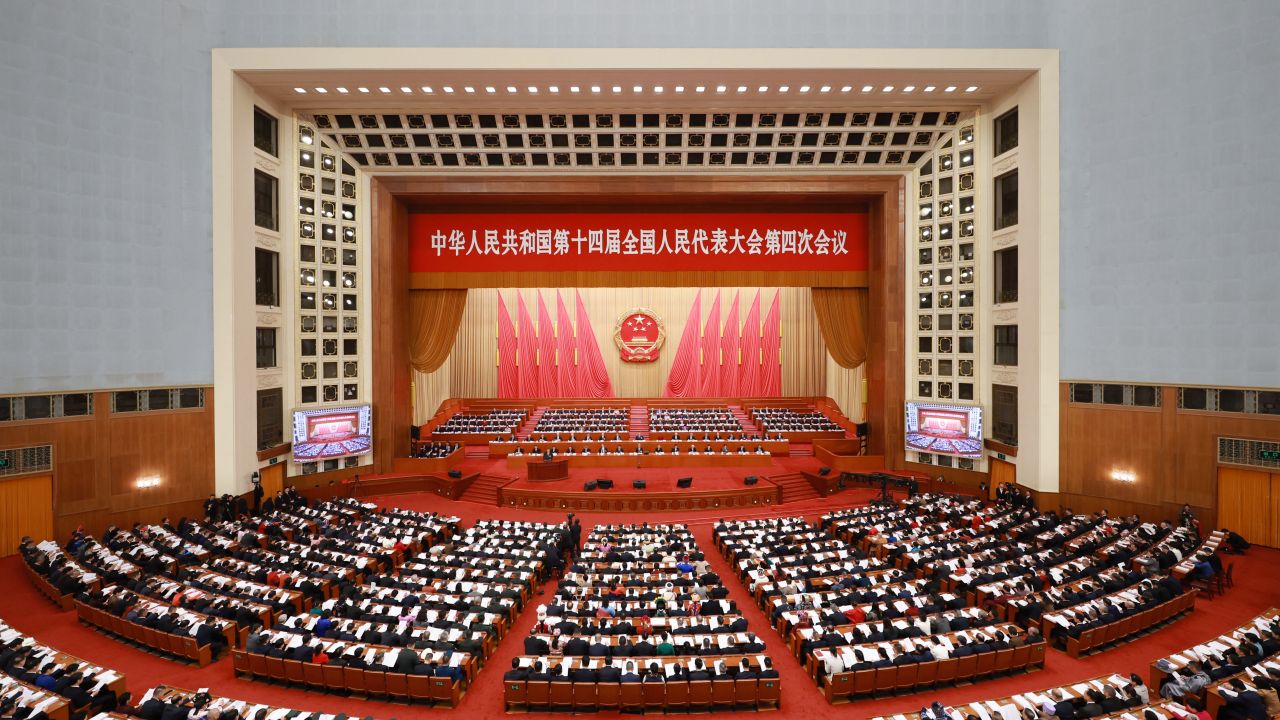
During China’s annual “Two Sessions,” the government released the Outline of the 15th Five-Year Plan for National Economic and Social Development of the People’s Republic of China. Among its chapters, Chapter 60 is devoted specifically to Taiwan affairs under the title “Promoting the Peaceful Development of Cross-Strait Relations and Advancing National Reunification.” The chapter is organized around two policy pillars: “advancing cross-strait economic cooperation” and “deepening cross-strait exchanges.”
The proposed measures include continued preferential policies for Taiwanese businesses and residents in mainland China, encouragement for Taiwanese firms to participate in China’s regional development strategies and the Belt and Road Initiative, support for Taiwanese enterprises to list on mainland capital markets, and expanded social exchanges in areas such as education, culture, and youth engagement. In policy rhetoric, Beijing frames these initiatives as part of a broader strategy of “cross-strait integration and development,” seeking to institutionalize Taiwan policy within China’s long-term national development planning.
However, when viewed from the broader perspective of international political economy and geopolitical transformation, the Taiwan-related provisions of the 15th Five-Year Plan reveal little genuine policy innovation. Instead, they largely extend the longstanding strategy of promoting economic integration and social interaction as instruments of political influence. In an era characterized by supply-chain restructuring, intensifying geopolitical competition, and mounting structural challenges within the Chinese economy, the effectiveness of such policy tools is increasingly open to question.
In this sense, the Taiwan policy embedded in the 15th Five-Year Plan appears less like a strategic breakthrough than a formal institutionalization of existing United Front logic. Beijing continues to emphasize economic incentives as the primary mechanism for shaping cross-strait relations, yet Taiwan’s strategic environment has gradually shifted toward security alignment with democratic partners in the Indo-Pacific region. The growing tension between these two structural trajectories raises important questions about the long-term viability of China’s Taiwan strategy.
1. Geoeconomic Competition and the Transformation of the Global Order
In recent years, strategic competition between the United States and China has expanded beyond traditional military and diplomatic arenas into the domain of global political economy. Washington and its allies have implemented a range of measures—including export controls, tariffs, investment screening mechanisms, and industrial subsidies—to reshape global supply chains and reduce technological dependence on China.
Within this evolving geoeconomic landscape, concepts such as “friend-shoring” and “de-risking” have become central to corporate and governmental strategies for supply-chain resilience. Advanced industries such as semiconductors, artificial intelligence, and critical manufacturing technologies are increasingly embedded within new networks of technological cooperation among the United States, Japan, Europe, and other partners.
At the same time, energy geopolitics has introduced additional uncertainty into China’s development environment. U.S. sanctions on Iranian oil exports and shifting political dynamics in energy-producing regions such as Venezuela have contributed to volatility in global energy markets. As the world’s largest energy importer, China remains heavily dependent on external supplies from the Middle East and other regions. Any disruption in these markets directly affects China’s industrial costs and macroeconomic stability.
Against this backdrop, Beijing faces a strategic environment shaped by supply-chain restructuring, technological decoupling, and geopolitical fragmentation. In such circumstances, Taiwan policy cannot be understood solely as a matter of cross-strait relations; it must also be viewed as part of China’s broader effort to maintain economic competitiveness and geopolitical influence within an increasingly contested international system.
Consequently, the Taiwan provisions in the 15th Five-Year Plan appear primarily symbolic. They reaffirm Beijing’s longstanding political objectives but do not fundamentally alter the structural constraints imposed by global geoeconomic competition.
2. Structural Pressures within China’s Domestic Economy
China’s domestic economic transformation further complicates the effectiveness of its Taiwan policy tools. Over the past two decades, China’s rapid growth was driven largely by real estate development, infrastructure investment, and export-oriented manufacturing. However, this growth model has increasingly shown signs of structural strain.
The real estate sector, once a central pillar of economic expansion, has entered a prolonged downturn following the debt crises of major property developers such as Evergrande and Country Garden. The contraction of property investment has not only weakened local government revenues but also dampened consumer confidence and financial stability.
Simultaneously, youth unemployment has emerged as a significant socio-economic challenge. At one point, China’s urban youth unemployment rate exceeded 20 percent, prompting authorities to suspend the publication of the indicator temporarily. High youth unemployment undermines household income expectations and constrains domestic consumption, thereby complicating efforts to rebalance the economy toward internal demand.
Local government debt also represents a growing fiscal burden. For years, local authorities relied on financing vehicles to fund large-scale infrastructure projects, often supported by land sales and property development. As the real estate sector slows and fiscal revenues decline, the sustainability of this model has come under increasing scrutiny.
In response, Beijing has promoted new economic concepts such as “dual circulation” and “new quality productive forces”, emphasizing technological innovation and industrial upgrading. Yet these initiatives require time to generate tangible results. During this transitional period, China’s economic attractiveness to foreign investors—including Taiwanese firms—has become less certain.
3. The Transformation of Taiwanese Investment Patterns
The restructuring of global supply chains has also reshaped the investment behavior of Taiwanese enterprises. For much of the past three decades, mainland China served as the primary destination for Taiwanese manufacturing investment due to three key advantages: low labor costs, a vast domestic market, and deep integration with global production networks.
Today, however, these conditions are changing. Rising labor costs in China have encouraged labor-intensive industries to relocate to Southeast Asia and South Asia. More importantly, technological competition between the United States and China has accelerated the reconfiguration of high-tech supply chains.
Many Taiwanese firms in the information and communications technology (ICT) sector have begun shifting production capacity to countries such as Vietnam, India, and Mexico. These relocations are not driven solely by economic considerations but also by geopolitical risk management.
A particularly significant development is the emergence of what analysts sometimes call “non-red supply chains”—technology networks designed to minimize exposure to China’s political and regulatory environment. In sectors such as semiconductors and advanced electronics, the United States and its partners are gradually constructing cooperative frameworks that exclude Chinese participation in critical technologies.
Within this evolving technological ecosystem, Taiwan has become a pivotal technological node in the global semiconductor industry. The island’s advanced manufacturing capabilities, particularly in leading-edge chip production, have elevated its strategic significance in global supply-chain governance. As a result, Taiwan’s economic leverage increasingly derives from its position within international technology networks rather than from cross-strait economic integration alone.
Under these conditions, Beijing’s traditional strategy of offering economic incentives to attract Taiwanese investment faces diminishing returns.
4. Security Alignment and the Limits of Economic Integration
For decades, Beijing’s Taiwan policy has rested on a central assumption: economic integration would gradually lead to political accommodation and eventual reunification. The logic was straightforward—deepening economic ties would increase Taiwan’s dependence on mainland markets and create domestic constituencies supportive of closer political relations.
Yet this assumption is increasingly challenged by changing security dynamics in the Indo-Pacific region.
In recent years, the First Island Chain security architecture—linking the United States, Japan, and regional partners—has gained renewed strategic significance. The U.S.–Japan alliance has strengthened its military posture in the Western Pacific, while trilateral cooperation among the United States, Japan, and Taiwan has expanded in areas such as maritime security, supply-chain resilience, and technological collaboration.
This evolving framework reflects shared concerns about regional stability and freedom of navigation. For many policymakers in the region, Taiwan’s security has become closely intertwined with the broader strategic balance in the Indo-Pacific.
Domestic public opinion in Taiwan has also shifted. Surveys consistently show growing support among Taiwanese citizens for maintaining close security ties with democratic partners such as the United States and Japan. At the same time, confidence in economic dependence on mainland China has declined.
Events such as Russia’s invasion of Ukraine and rising military tensions in the Taiwan Strait have heightened public awareness of security risks. As a result, national security considerations increasingly outweigh purely economic incentives in shaping Taiwan’s strategic outlook.
Under these circumstances, Beijing’s reliance on economic integration as the primary instrument of influence appears increasingly inadequate. While the 15th Five-Year Plan formally institutionalizes Taiwan policy within China’s national development framework, its core strategy remains anchored in a paradigm that assumes economic interdependence will ultimately reshape political alignments.
However, Taiwan’s evolving position within the Indo-Pacific security architecture suggests that security alignment may now play a more decisive role than economic integration in determining the island’s strategic orientation.
5. Conclusion: Institutionalized Policy, but Limited Strategic Innovation
The inclusion of Taiwan policy in China’s 15th Five-Year Plan demonstrates Beijing’s intention to treat cross-strait relations as a long-term component of national development strategy. Institutionalizing policy frameworks can enhance bureaucratic coordination and signal political commitment.
However, institutionalization does not necessarily equate to strategic innovation. The Taiwan provisions of the 15th Five-Year Plan largely reaffirm existing policy instruments—economic incentives, social exchanges, and integration initiatives—without introducing fundamentally new mechanisms capable of addressing the changing geopolitical environment.
In a world characterized by supply-chain realignment, technological rivalry, and Indo-Pacific security cooperation, Beijing’s continued reliance on economic integration may no longer be sufficient to shape Taiwan’s political trajectory.
In this sense, the Taiwan policy articulated in the 15th Five-Year Plan resembles old wine in a new bottle. The policy framework appears more systematic and institutionalized, yet its underlying strategic logic remains largely unchanged. As Taiwan increasingly embeds itself within global technology networks and regional security partnerships, the gap between Beijing’s policy assumptions and the evolving geopolitical reality may continue to widen.
カテゴリー
最近の投稿
- 中国代表団の日本領土・北方四島訪問と迫りくる「米中露戦後秩序の構図」 トランプが「米中露首脳会談」提案
- フライング・タイガースに端を発する東アジアの歴史認識を巡る争い
- トランプが中露に石油精製製品の増産・供給を要請した結果、習近平の「米中露戦後秩序の構図」を強化か?
- 岩屋氏の中国に対する「日中共同声明の再確認提案」は無駄 習近平が何を狙っているのかをわかっていない
- 共産主義者を追い出す
- 習近平の「米中露戦後秩序の構図」は、日本を「新型軍国主義」と指摘することによって何を狙っているのか?
- The Flying Tigers and the Battle over Wartime Memory in East Asia
- WWⅡの同盟国・米中の敵国は日本 そこに潜む中国の恐るべき「新型軍国主義・日本とG2」構図
- Casting out the communists
- トランプ「中国は同盟国」発言は事前に習近平と調整 梯子を外された高市首相
RSS