

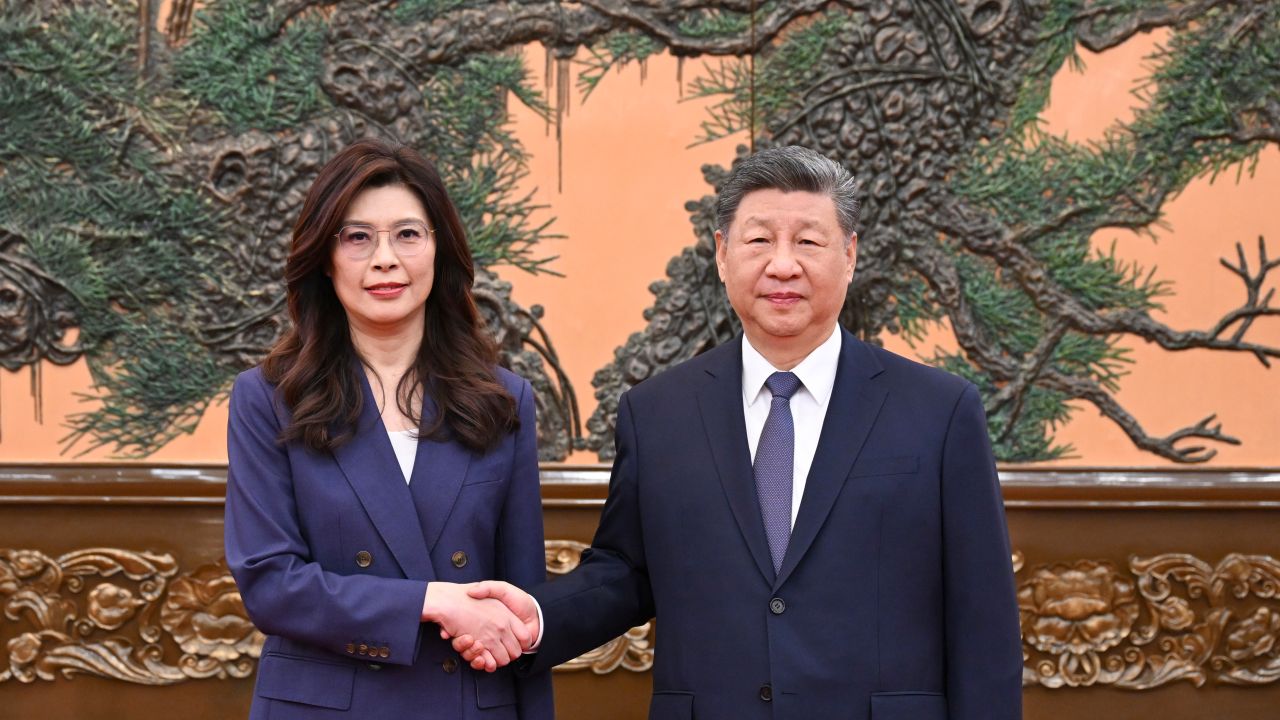
In Taiwan, meetings of this kind are never judged simply by whether they take place. They are judged by who appears to set the terms, who gains symbolic advantage, and whether Taiwan’s own democratic institutions are quietly pushed to the margins in the process. That is why the recent meeting between Kuomintang (KMT) Chairwoman Cheng Li-wun and Chinese leader Xi Jinping has generated such close attention. The issue is not merely that contact occurred. Rather, the meeting has reopened a more difficult question in Taiwan’s strategic debate: under what institutional conditions does engagement across the Strait take place, and whose political logic ultimately defines its meaning?
At first glance, the Zheng–Xi meeting may seem like another episode in the long history of cross-Strait party-to-party interaction. Some observers regard such contact as useful, especially at a time when official communication between the two governments remains weak and the broader security environment is becoming more tense. Others see it as deeply problematic, arguing that any such encounter risks being absorbed into Beijing’s united front framework and deployed against Taiwan’s political subjectivity. Both reactions are understandable. Yet neither position, by itself, fully captures the significance of the meeting.
The analytical value of the Zheng–Xi meeting lies elsewhere. It reveals three interrelated structural issues that deserve closer attention: the hierarchy of engagement across the Strait, the deeper institutional asymmetry between Taiwan and China, and the limited agenda-setting capacity displayed by Taiwan’s side in this particular encounter. The meeting should therefore be read not simply as an instance of engagement, but as an event that illuminates the politics of engagement itself.
Hierarchy of Engagement
The first issue concerns the political hierarchy embedded in cross-Strait exchanges. In Taiwan’s democratic system, political parties are electoral and civic organizations. They may compete for power, shape public debate, and influence national policy, but they do not automatically embody the state. When a party leader meets a foreign counterpart, such interaction is generally interpreted as political, but not necessarily official or sovereign in character.
The Chinese side operates according to an entirely different institutional logic. In the People’s Republic of China, the Chinese Communist Party (CCP) is not merely one political actor among others. It is the institutional center of the state itself. The party leads, defines, and disciplines the state apparatus. As a result, any meeting between the CCP leadership and a Taiwanese political figure is unlikely to remain at the level of neutral party exchange. Even if presented in that form, it is embedded within a political structure in which party contact carries state-like authority and symbolic weight.
This is precisely why many in Taiwan do not react to such meetings with calm detachment. What concerns them is not contact alone, but the possibility that contact is gradually being reclassified within Beijing’s own political hierarchy. From Taiwan’s side, such a meeting may be described as party-to-party engagement. From Beijing’s side, it can be elevated into a politically meaningful signal about cross-Strait relations, social integration, or differentiated treatment of Taiwan’s domestic actors.
This asymmetry creates a hierarchy of engagement. The same act of meeting does not carry the same political status on both sides of the Strait. Taiwan may interpret it as a partisan or semi-civil channel; Beijing may incorporate it into a broader political narrative. The result is not simply a difference of opinion, but a structural imbalance in how engagement is institutionally understood and publicly used.
Institutional Asymmetry Across the Strait
This leads to the second issue: institutional asymmetry. In international relations, asymmetry is often understood first in material terms—differences in size, capability, markets, or coercive power. In the cross-Strait context, however, asymmetry is not merely material. It is also institutional, interpretive, and political.
Taiwan’s political order is pluralistic, democratic, and procedurally constrained. Political actors operate under electoral pressure, legal oversight, media scrutiny, and party competition. No party can speak for the state without contestation. China’s political order is organized along a very different axis. It is a party-state system in which authority is centralized, representation is tightly controlled, and political legitimacy is not generated through democratic competition. Even when the language of “party exchange” is used on both sides, the underlying institutions are not parallel.
This difference matters because institutions shape not only behavior, but also the meaning of political acts. Taiwan may see engagement as a practical effort to preserve communication, reduce friction, or respond to domestic expectations. Beijing may view the same encounter as part of a broader political project—one that reinforces particular narratives of national belonging, political alignment, or cross-Strait connectivity under CCP-defined terms.
This is why the reaction of Taiwan’s Mainland Affairs Council deserves attention. Its regret that the meeting bypassed formal official mechanisms was not simply a bureaucratic complaint. It reflected a deeper institutional concern: when government-to-government channels are weak, party-level interaction can begin to occupy political space that ideally belongs to democratically accountable institutions. In Taiwan, this creates ambiguity. In China, it creates strategic opportunity.
For analysts of China, this point should not be underestimated. The CCP has long demonstrated an ability to absorb tactical interactions into larger strategic narratives. Meetings are never only meetings. They are also signals, symbols, and instruments within a broader political framework. If one side treats engagement as communication while the other treats it as political incorporation, then the asymmetry lies not only in power, but in the institutional rules of interpretation.
Agenda-Setting Failure
The third issue is agenda-setting failure. In the study of small states and asymmetric interaction, weaker actors are not assumed to be entirely passive. Even under severe structural constraints, they may still exercise agency through selective issue framing, narrative redirection, symbolic signaling, or institutional linkage. For weaker actors, agency rarely begins with material leverage; it begins with the ability to create, redirect, or at least complicate the agenda.
That, more than the meeting itself, was what seemed missing here.
Prior to the Zheng–Xi meeting, many observers expected the event to unfold broadly along Beijing’s preferred script. In retrospect, that expectation appears to have been largely correct. The encounter did not produce a notable discursive shift, nor did it generate a new agenda centered on Taiwan’s institutional concerns, demands for reciprocity, or anxieties over political security. The meeting took place, but the terms of meaning remained largely within a familiar framework.
To be fair, one should acknowledge the structural limits of the situation. It is not easy for any Taiwanese political actor to reshape discourse in a tightly managed encounter with the CCP leadership. The room for improvisation is small, and the symbolic terrain is already heavily conditioned by the stronger side. Yet precisely for this reason, agenda-setting matters all the more. If a weaker actor cannot alter the balance of power, it must at least try to affect the balance of interpretation.
That did not happen in any substantial way here. The problem, then, is not that the meeting occurred. The problem is that Taiwan’s side appeared to have little capacity to redefine what the meeting was about. In that sense, the Zheng–Xi meeting can be read as a case of agenda-setting failure: not a failure to communicate, but a failure to shape the communicative field.
Limited Economic Substance
This analytical framework also helps place the announced preferential measures for Taiwan in a more realistic perspective. The measures discussed after the meeting—including opportunities for digital content creators, micro-enterprises, and youth-oriented exchange—may offer some niche openings. But their broader structural significance should not be overstated.
For large Taiwanese firms, business decisions today are increasingly shaped by geopolitical uncertainty, supply-chain diversification, regulatory predictability, and the broader strategic environment between China and the United States. Under these conditions, modest incentives are unlikely to trigger major investment shifts. The practical benefits of such policies may remain limited to localized tourism, service activity, or selected small-scale sectors in areas such as Shanghai and Fujian.
This does not mean the policies are meaningless. Their significance may simply be more political than economic. They project selective openness, encourage differentiated forms of connection, and sustain the appearance of continued cross-Strait opportunity under Beijing’s terms. In other words, their value may lie less in transforming Taiwan’s economic structure than in shaping the optics of engagement.
Implications for Taiwan’s Elected Government
The longer-term implications of the Zheng–Xi meeting may therefore lie less in immediate policy substance than in the pressure it places on Taiwan’s elected government. Meetings of this kind can affect domestic discourse by raising the question of whether the government should restore, expand, or reconfigure channels of communication with China. Even when such meetings do not directly alter official policy, they can still shift the surrounding political atmosphere.
This is why future developments deserve close observation, especially the prospect of expanded youth exchanges under party auspices. Social exchange, in itself, is not unusual and should not be simplistically demonized. But the institutional context matters. If such exchanges gradually form an alternative political channel—one that bypasses formal state institutions while still carrying political significance in Beijing’s party-state logic—then their long-term implications may extend well beyond people-to-people contact.
Conclusion
The Zheng–Xi meeting should not be reduced to a simple question of whether engagement is good or bad. Its deeper significance lies in what it reveals about the politics of engagement under asymmetry.
Three points stand out. First, cross-Strait engagement is embedded in a hierarchy of political meaning, because the same meeting carries different institutional status in Taiwan and China. Second, this hierarchy is reinforced by institutional asymmetry between Taiwan’s democratic party politics and China’s party-state system. Third, under such conditions, Taiwan’s side faces serious difficulty in exercising agenda-setting capacity, and the Zheng–Xi meeting illustrates the consequences of that limitation.
For Taiwan, the issue is not whether engagement should be romanticized or rejected outright. The more difficult task is to ensure that engagement does not come at the cost of institutional subjectivity, agenda-setting capacity, and democratic accountability. This is not an easy balance to maintain. But it is precisely the balance Taiwan must learn to defend if engagement is to remain a strategic instrument rather than become merely another layer of asymmetry.
カテゴリー
最近の投稿
- WWⅡの同盟国・米中の敵国は日本 そこに潜む中国の恐るべき「新型軍国主義・日本とG2」構図
- Casting out the communists
- トランプ「中国は同盟国」発言は事前に習近平と調整 梯子を外された高市首相
- 習近平の訪米:日本と台湾は米中交渉のどこに注目すべきか
- 米シンクタンク「米軍は第二列島線まで退くべき」(台湾放棄、日米同盟破棄…)の衝撃 その1 実現性は?
- 「習近平が倒れた」という噂の正体 BRICS首脳会議で
- Xi Jinping’s US Visit: What Japan and Taiwan Should Watch in US–China Bargaining
- 「習近平訪米の計算式」Ⅲ 中東・アフリカの要衝に王手! エジプトと軍事演習
- 「習近平訪米の計算式」Ⅱ 世界人口の42%を占める上海協力機構 習近平「イランとの距離の取り方」
- 「習近平訪米の計算式」Ⅰ トランプに会っても国連総会は欠席するわけ
RSS