

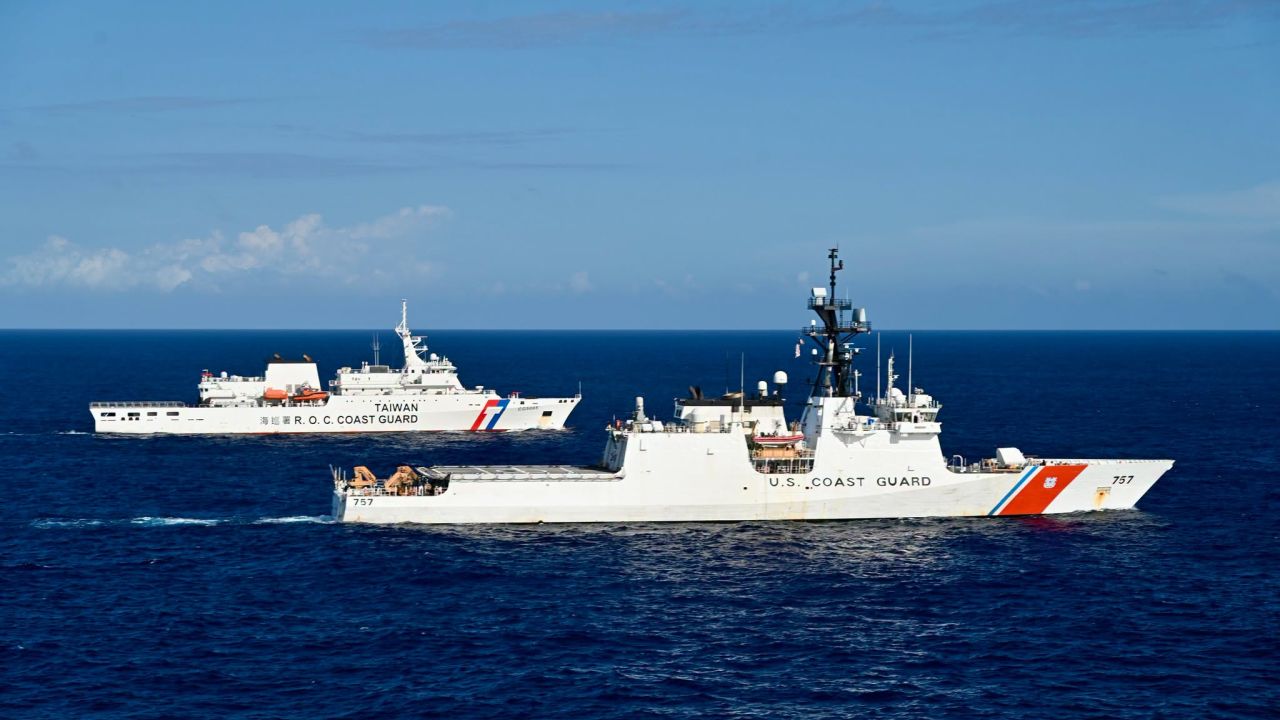
Taiwan remained outside ASEAN’s formal diplomatic language, yet the public display of Taiwan–US coastguard cooperation points towards a more operational form of regional inclusion.
During the ASEAN-related meetings in Manila, US Secretary of State Marco Rubio placed the Taiwan Strait within a wider discussion of freedom of navigation and the risks created when states seek to control international waterways. ASEAN’s joint communiqué did not reproduce that broader strategic framing. It reaffirmed the United Nations Convention on the Law of the Sea, freedom of navigation and overflight in the South China Sea, and transit passage through straits used for international navigation, but did not mention the Taiwan Strait.
This gap reflects ASEAN’s strategic boundary. Member states support an open maritime order but remain unwilling to incorporate Taiwan into a collective regional security position. Only days later, however, the American Institute in Taiwan released an image of the Taiwan Coast Guard Administration cutter Taipei sailing alongside the US Coast Guard cutter Midgett. The accompanying statement referred to search and rescue, disaster response, marine conservation, illegal fishing and maritime drug interdiction.
No date, location or operational designation was disclosed. The image nevertheless made visible a relationship that had developed largely through memoranda, professional exchanges and quiet operational contacts. Taiwan remained absent from ASEAN’s diplomatic text, but appeared inside a more practical maritime law-enforcement network.
White Hulls in the Same Frame
The publication of the image was a calibrated strategic disclosure. Washington allowed the cooperation to be seen while avoiding phrases such as “joint patrol”, “Taiwan Strait operation” or “military exercise”. Public visibility conveyed political support and operational familiarity; ambiguity limited immediate escalation and preserved room for future cooperation.
The image featured two substantial operational platforms. Taiwan’s 4,000-tonne Taipei is a major patrol and rescue cutter. Midgett is a Legend-class national security cutter capable of extended deployments, law enforcement and integration with naval operations. During a five-month Western Pacific deployment, Midgett operated under the tactical control of the US Seventh Fleet and conducted joint operations, professional exchanges and capacity-building activities with partners in Japan, the Philippines, South Korea and Singapore.
Taiwan and the United States established a coastguard working group in 2021, covering marine-resource protection, illegal fishing, search and rescue, environmental protection and professional training. The latest disclosure moves that relationship from administrative cooperation towards publicly recognisable operational association. Taiwan is no longer presented solely as an island requiring protection. The image depicts Taiwan as a maritime actor with enforcement authority, operational assets and the capacity to provide regional public goods.
Why White Hulls Matter
“White hull” is not a formal category of vessel. Maritime-security analysis uses the term to distinguish coastguards and maritime law-enforcement agencies from the “grey hulls” of national navies. The distinction concerns institutional mandate as much as paint colour. Grey hulls are organised primarily for military deterrence, combat and power projection. White hulls operate through law enforcement, search and rescue, fisheries management, customs enforcement, environmental protection and navigational safety.
White hulls can operate in political space often unavailable to warships. Coastguard cooperation does not require a mutual-defence treaty. Search-and-rescue exercises need not be treated as military integration. Action against illegal fishing enjoys broad international legitimacy. Communications procedures, vessel identification, evidence collection and coordinated sailing can therefore develop below the threshold of formal alliance politics.
The lower political threshold does not remove strategic effect. Coastguards increasingly operate at the centre of sovereignty disputes and grey-zone competition. They can assert jurisdiction, maintain access, document coercion and challenge rival enforcement claims without immediately producing the symbolism of naval confrontation.
Midgett illustrates this duality. The cutter belongs to a law-enforcement service, yet its Western Pacific deployment linked humanitarian operations, maritime enforcement, allied capacity-building, logistics and naval coordination. White hulls remain institutionally distinct from navies, while their operational networks increasingly overlap.
From Bakumatsu Black Ships to Indo-Pacific White Hulls
For Japanese readers, “white hulls” also permit a historical metaphor. Commodore Matthew Perry’s arrival at Uraga in 1853 entered Japanese memory through the image of the kurofune, or “black ships”. Steam power, heavy armament and gunboat diplomacy forced the Tokugawa shogunate to confront a Western-dominated international order. The black ships came to symbolise external pressure, institutional disruption and Japan’s coerced opening.
The contemporary white-hull presence in the Western Pacific rests on a different form of legitimacy. American maritime power now enters regional institutions through search and rescue, law enforcement, disaster relief, fisheries protection, information sharing and partner capacity-building. The black ships sought access through concentrated coercion. White hulls accumulate influence through repeated cooperation and institutional connectivity.
Both forms remain expressions of American sea power, but they organise access and influence through different mechanisms. Black-ship diplomacy concentrated coercive power in a single encounter; white-hull cooperation embeds influence through repeated operations, shared standards and institutional connectivity. White-hull cooperation also remains connected to naval strategy, alliances and deterrence.
The black ships transformed Japan through a dramatic encounter. White hulls reshape the regional order through routine practices: common communications procedures, compatible training, shared information, coordinated search-and-rescue protocols and professional relationships among maritime agencies. Their cumulative institutional effect may prove more durable than any single voyage.
China: A Contest over Jurisdiction
China’s pressure on Taiwan increasingly operates through administration and law enforcement, not solely through the People’s Liberation Army Navy. Chinese coastguard cutters, maritime-surveillance vessels and domestic regulations support a broader attempt to present waters around Taiwan as spaces in which Beijing already possesses enforcement jurisdiction.
The language of routine law enforcement is central to this approach. Patrols, inspections, warnings and boarding demands create the appearance of ordinary administrative control. Repeated enforcement activity can gradually convert a disputed claim into an operational practice. Beijing seeks not only to increase the presence of Chinese vessels, but also to establish the premise that Chinese agencies possess the authority to regulate conduct around Taiwan.
The image of Taipei and Midgett challenges that premise. It presents Taiwan as a maritime enforcement actor with its own vessels, legal responsibilities and international partners. Taiwan appears neither as an object within China’s coastguard jurisdiction nor merely as a military flashpoint. The image places Taiwan within international maritime governance, where search and rescue, anti-smuggling operations, fisheries enforcement and navigational safety require cooperation among capable authorities.
Beijing’s longer-term concern is therefore larger than the presence of one American cutter. Taiwan may gradually connect with overlapping coastguard relationships involving the United States, Japan and the Philippines. A denser network of vessel identification, information exchange, incident recording and public documentation would make Chinese grey-zone operations more visible and harder to define unilaterally. China would retain material advantages but face greater competition over the legal and political interpretation of events at sea.
Japan and the Emerging White-Hull Network
Japan should read the image within a wider maritime architecture. Japan, the United States and the Philippines have expanded cooperation through coastguard exercises, maritime-domain awareness, law-enforcement training and capacity-building. Taken together, these overlapping relationships point towards an emerging functional network linking the US Coast Guard, the Japan Coast Guard, the Philippine Coast Guard and the Taiwan Coast Guard Administration.
No common framework or standing coordination mechanism yet connects all four agencies. Taiwan’s diplomatic position and regional one-China policies constrain its formal participation in a US–Japan–Philippines structure. Maritime networks, however, often develop through overlapping bilateral and trilateral arrangements rather than through a single institutional centre.
Search and rescue, disaster response, illegal-fishing enforcement, pollution control, information exchange and professional training offer feasible points of connection. Each activity serves an immediate public purpose, while repeated cooperation improves communications, surveillance and operational familiarity.
The geographical logic is particularly important for Japan. Japanese energy and commercial routes pass through waters around Taiwan, the Bashi Channel and the South China Sea. The East China Sea, Taiwan Strait and South China Sea remain diplomatically distinct, but are connected by shipping, undersea infrastructure and military geography.
Taiwan’s functional participation could help close an important maritime-information gap between Japan’s south-western islands, Taiwan’s eastern waters, the Bashi Channel and northern Luzon. Tokyo need not demand that ASEAN incorporate the Taiwan Strait into a common security declaration. Practical coastguard connectivity can improve regional awareness without forcing Southeast Asian governments into an explicit alignment choice.
Japan must nevertheless preserve the civilian and public-goods character of such cooperation. Turning every coastguard initiative into a component of military containment would weaken regional acceptance. Japan’s comparative advantage lies in connecting maritime capability with professional law enforcement, infrastructure, training and crisis management.
The Philippines: Balancing Below the Threshold of War
The Philippine experience shows why white-hull cooperation has become central to Indo-Pacific security. Manila faces repeated Chinese coastguard pressure around Scarborough Shoal and Second Thomas Shoal. Water cannon, obstruction and close manoeuvring impose costs while remaining below the conventional threshold of armed conflict.
A naval response to every coastguard confrontation would create unacceptable escalation risks. Diplomatic protests alone cannot maintain resupply, fisheries protection or physical presence. Coastguard partnerships provide an intermediate instrument: surveillance, documentation, communications, training and logistics without automatically invoking military confrontation or treaty obligations.
American coastguard deployments have already supported Philippine capacity-building, search-and-rescue training and preparation for multilateral exercises. These activities have immediate civilian applications and wider strategic consequences. They allow Manila to strengthen presence and endurance while keeping many interactions below the threshold of military conflict.
Taiwan and the Philippines face different sovereignty disputes and diplomatic constraints, but both confront efforts by Beijing to normalise Chinese jurisdiction through coastguard operations and administrative language. Fisheries management, search and rescue, typhoon response, anti-smuggling operations and environmental protection offer areas for practical exchange without requiring a formal security relationship.
For Manila, the AIT image also suggests that American white-hull engagement is becoming a wider Western Pacific practice rather than a response confined to individual South China Sea incidents. A broader network may distribute operational and political pressure. Its durability will depend on whether participating governments can preserve civilian legitimacy while strengthening real enforcement capacity.
From Protected Object to Institutional Participant
The AIT image marks a change in Taiwan’s regional position: from an object of protection to an operational participant in maritime governance.
Indo-Pacific competition is increasingly conducted through institutions below the level of military alliance. China uses coastguards, public vessels, administrative regulations and routine patrols to establish jurisdictional presence. The United States and its partners build alternative legitimacy through training, coordinated sailing, maritime-domain awareness, anti-illegal-fishing operations and search-and-rescue networks.
The contest concerns more than fleet size. It concerns which authorities can issue warnings, board vessels, preserve access, document incidents, define lawful conduct and persuade regional audiences that their actions constitute legitimate governance.
Grey hulls continue to define the upper limits of deterrence and war. White hulls increasingly shape the daily order of the grey zone.
Taiwan’s absence from the ASEAN communiqué reflects the political limits of regional diplomacy. The white-hull relationship offers a different form of entry. Operational cooperation can expand even where formal political inclusion remains blocked.
The photograph publicly recognises Taiwan as a maritime-enforcement partner with the capacity to contribute to regional governance. Naval deterrence continues to define the upper limits of security competition, while coastguard cooperation expands Taiwan’s institutional access below the alliance threshold.
Perry’s black ships announced a new order through concentrated coercive power. Contemporary white hulls work through another mechanism. They connect partners, establish routines and build jurisdictional legitimacy one exercise, one voyage and one shared maritime function at a time.
カテゴリー
最近の投稿
- 「習近平訪米の計算式」Ⅲ 中東・アフリカの要衝に王手! エジプトと軍事演習
- 「習近平訪米の計算式」Ⅱ 世界人口の42%を占める上海協力機構 習近平「イランとの距離の取り方」
- 「習近平訪米の計算式」Ⅰ トランプに会っても国連総会は欠席するわけ
- 不正流出したネパール・中国「土石流」監視カメラ映像は、ロイターが配信権を獲得して正当化されたのか?
- 垣間見えた未来
- A Glimpse of the Future
- 中国はネパールと中国(チベット)国境の土石流をどのように報道し、どのように報道しなかったか?
- イラン戦争で中国が「新OPEC(石油輸出国機構)」に? 中国の絶大な「石油力」が世界の市場を動かす
- トランプが下野したら、「世界は米国よりも中国を信用する」という世論調査結果を覆せるのか?
- 開放の裏で進む統制の厳格化:中国の新たな出入国規定と人の移動の安全保障化
RSS