

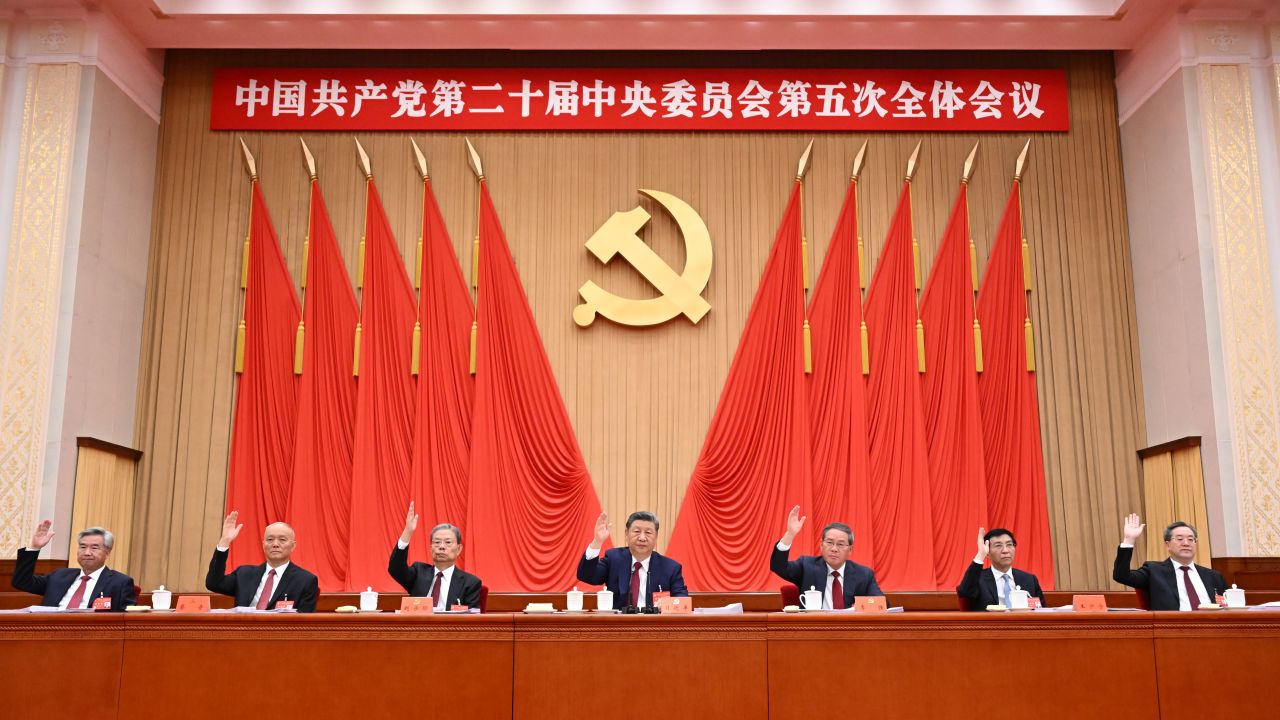
The Fifth Plenum reveals how China’s increasingly institutionalised system of political discipline is reshaping local governance, military leadership and Beijing’s approach to Taiwan.
The Chinese Communist Party’s Fifth Plenum concluded on 29 October 2026, adopting a resolution on comprehensive and rigorous Party governance and announcing that the 21st Party Congress would convene in the second half of 2027. The scale of personnel changes attracted particular attention. Of the 376 full and alternate Central Committee members elected in 2022, only 279 attended the meeting, a difference of 97, or approximately one-quarter of the original membership. Some absences were associated with disciplinary investigations, although the figures do not establish that everyone missing from the meeting was under investigation. The plenum also confirmed the expulsion of 33 officials and elected Central Military Commission (CMC) Vice-Chairman Zhang Shengmin to the Politburo.
Fourteen years after Xi Jinping assumed power, anti-corruption has evolved from a campaign against official misconduct into a permanent framework for political supervision and organisational control. The latest decisions raise questions about the relationship between political loyalty and effective administration, particularly as Xi prepares for the next Party Congress. The pressures generated by this system are increasingly visible in local government, military leadership and the management of relations across the Taiwan Strait.
-
Political Loyalty, “Two-Faced” Officials and Democratic Centralism
Xi has repeatedly criticised liangmianren, or “two-faced” officials, who publicly profess loyalty to the Party centre while pursuing private interests or maintaining local political networks. The Fifth Plenum reinforced the demand to prevent senior local officials, particularly Party secretaries and other leading cadres known as yibashou, from turning their jurisdictions into personal power bases. Practices such as arbitrary decision-making, factional control and the replacement of collective deliberation with the preferences of a single leader have become important targets of internal Party supervision.
The leadership has presented democratic centralism as an organisational response to these problems. Within the CCP, the democratic component refers to internal deliberation, collective discussion, criticism and self-criticism, through which Party members are expected to examine competing views before reaching decisions. The centralist component requires members and subordinate organisations to implement decisions once they have been adopted. This differs fundamentally from liberal democracy, where electoral competition, political pluralism and institutional checks on power provide mechanisms for public accountability. Democratic centralism operates within the Communist Party’s hierarchical organisation rather than through competition between political parties.
The difficulty lies in the relationship between collective deliberation and political loyalty. Beijing wants to prevent local Party secretaries from exercising unchecked personal authority, while simultaneously demanding strict adherence to the decisions and political authority of the central leadership. Local officials may hesitate to challenge unrealistic policy targets or report implementation difficulties when disagreement could be interpreted as insufficient political commitment. A system intended to eliminate “two-faced” behaviour may encourage public conformity without ensuring that genuine disagreements reach the leadership. The effectiveness of democratic centralism depends partly on whether criticism and collective discussion remain meaningful within an increasingly centralised political hierarchy.
-
From Political Rules to Institutionalised Discipline
The CCP’s present governance difficulties cannot be attributed simply to an absence of political rules. In 2016, the Sixth Plenum of the 18th Central Committee adopted the Guidelines on Political Life within the Party under the New Circumstances and the Regulations on Internal Party Supervision. These documents established detailed expectations concerning democratic centralism, collective leadership, political discipline and supervision of senior officials. A decade later, the central challenge concerns how an extensive framework of disciplinary requirements operates within the bureaucracy.
The standards used to evaluate officials have also changed. During earlier phases of China’s economic development, local cadres were often assessed heavily on GDP growth, infrastructure construction and their success in attracting investment. Economic performance remains part of the evaluation system, but political loyalty, implementation of central directives and Party-building responsibilities have acquired greater prominence. The 2019 Regulations on the Assessment of Party and Government Leading Cadres explicitly placed political standards first. Political reliability has consequently become central to career advancement, alongside the continuing demands of economic management.
The expansion of disciplinary inspections, supervisory investigations and administrative assessments has created additional pressures for local and lower-level officials. These mechanisms seek to prevent corruption and restrain local power networks, but they may also encourage bureaucratic risk avoidance. For an official whose career could be damaged by an unsuccessful initiative, postponing a difficult decision or seeking instructions from higher authorities may appear safer than exercising independent judgement. Meetings, inspections and declarations of support for central policies become visible evidence of compliance, while investment decisions, fiscal commitments and industrial projects require officials to accept risks that are harder to control.
This behaviour can be described as performative compliance and substantive inaction. Its significance extends beyond ordinary bureaucratic inefficiency. As China enters its Fifteenth Five-Year Plan period, local governments face mounting fiscal pressures while being asked to develop artificial intelligence, robotics and advanced manufacturing. These industries require cooperation with private enterprises, careful allocation of public resources and the ability to respond to changing commercial conditions. Officials primarily concerned with avoiding disciplinary liability may be reluctant to make precisely the decisions necessary for industrial transformation. The accumulation of political rules can strengthen supervision while leaving insufficient room for administrative initiative.
-
Military Purges, Political Loyalty and the Next CMC
The continuing removal of senior People’s Liberation Army (PLA) officers, including Zhang Youxia and Liu Zhenli, has left considerable uncertainty surrounding China’s military leadership. Much attention has focused on vacancies within the CMC and the officers temporarily responsible for particular functions. These questions matter for the military’s immediate administration, but the more consequential development will be the composition of the leadership emerging from the 21st Party Congress in 2027. Xi’s choices will reveal how he intends to rebuild the PLA’s senior command after successive rounds of disciplinary investigations.
The issue recalls the longstanding Communist distinction between being politically red and professionally expert. Military leaders are expected to demonstrate both political loyalty and operational competence. The recent purges have intensified scrutiny of political reliability, raising the possibility that loyalty will carry greater weight in senior appointments. Politically trusted commanders are not necessarily less capable military professionals. The concern is whether an increasingly loyalty-centred promotion system allows sufficient room for operational experience, independent professional assessment and candid discussion of military risks.
For Taiwan and Japan, these developments require more careful interpretation than the assumption that military purges will prevent Beijing from undertaking major operations. A full-scale conflict would demand extensive logistics, coordinated command arrangements and substantial military resources. Personnel disruption could complicate such preparations, but it cannot establish that Chinese leaders would rule out the use of force. The PLA’s capabilities and political willingness to undertake military operations must be assessed separately.
Beijing also possesses a wide range of coercive instruments below the threshold of open warfare. Coast guard patrols, military aircraft operations, joint maritime and aerial patrols and other grey-zone activities can sustain pressure without requiring the resources associated with large-scale combat. Their relative operational and political costs may make them attractive instruments of coercion, although repeated encounters carry risks of accident and escalation. Such activities can exhaust the response capacity of Taiwan and Japan while gradually changing established patterns of operation in surrounding waters and airspace. The important indicators after the military leadership reshuffle will include both the personnel selected for the new CMC and the frequency, intensity and coordination of Chinese grey-zone operations.
-
Xi’s Leadership Continuity and Taiwan’s Security Concerns
The decision to convene the 21st Party Congress in the second half of 2027 establishes the timetable for China’s next leadership arrangements. Xi will be 74, and the informal conventions that previously encouraged leadership turnover after two five-year terms have lost much of their force. No successor has been publicly designated. Although a fourth term as CCP general secretary has not been formally confirmed, the institutional and personnel decisions surrounding the Fifth Plenum indicate that leadership continuity remains central to preparations for the next congress.
The Taiwan government’s assessment places particular emphasis on the regional consequences of China’s internal political developments. At a public event on 2 November, Mainland Affairs Council Deputy Minister Shen Yu-chung expressed concern that the concentration of authority around Xi, combined with limited internal checks and corrective mechanisms, could increase the risk of policy rigidity. Shen also warned that Beijing might accelerate an approach described as governing Taiwan before unification (未統先治), seeking to establish the appearance of administrative or jurisdictional authority over Taiwan before any formal political settlement.
Such an approach could involve the continued normalisation of military and coast guard operations around Taiwan, interference in democratic processes and other forms of political pressure. These are concerns articulated by Taiwan’s authorities, rather than evidence that Beijing has already decided on a particular course of action. Their significance lies in the possibility that political consolidation in Beijing may coexist with sustained coercive activity across the Taiwan Strait. Domestic governance difficulties do not automatically produce external aggression, but changes in China’s leadership structure and military command warrant close observation.
Japan faces related questions in the East China Sea and around its southwestern islands. The immediate concern is how China’s political and military institutions translate central directives into operational behaviour. As routine military and coast guard activities expand, maintaining communication and preventing miscalculation become important alongside deterrence and defence preparedness.
Conclusion: Political Control and the Limits of Governing Capacity
The Fifth Plenum illustrates the extent to which Xi has institutionalised political discipline as an instrument of Party governance. Rules introduced in 2016 have been reinforced by successive rounds of supervision, disciplinary enforcement and personnel adjustment. The continuing emphasis on political loyalty also exposes tensions between central authority, collective decision-making and the discretion required for effective administration.
The same tensions extend to the military. Xi needs commanders who are politically reliable and professionally capable, just as the Party needs local officials who respect central authority while exercising sufficient judgement to address economic and social problems. The durability of the present political system will depend partly on whether these requirements can be reconciled in practice.
The significance of the 2027 Party Congress extends beyond Xi’s personal continuation in office. The composition of the next political and military leadership, the treatment of local administrative initiative and China’s conduct around Taiwan and the East China Sea will provide important evidence of how its governing institutions are evolving. Political loyalty can be enforced through disciplinary rules; effective governance still depends on the willingness and ability of officials to exercise judgement, report problems and assume responsibility.
カテゴリー
最近の投稿
- Xi Jinping’s Political Consolidation Ahead of 2027: Party Discipline, Military Purges and China’s Governance Dilemma
- Learning from China
- 深圳APECでの「習近平・高市」会談はあり得るか?
- 中国代表団の日本領土・北方四島訪問と迫りくる「米中露戦後秩序の構図」 トランプが「米中露首脳会談」提案
- フライング・タイガースに端を発する東アジアの歴史認識を巡る争い
- トランプが中露に石油精製製品の増産・供給を要請した結果、習近平の「米中露戦後秩序の構図」を強化か?
- 岩屋氏の中国に対する「日中共同声明の再確認提案」は無駄 習近平が何を狙っているのかをわかっていない
- 共産主義者を追い出す
- 習近平の「米中露戦後秩序の構図」は、日本を「新型軍国主義」と指摘することによって何を狙っているのか?
- The Flying Tigers and the Battle over Wartime Memory in East Asia
RSS