

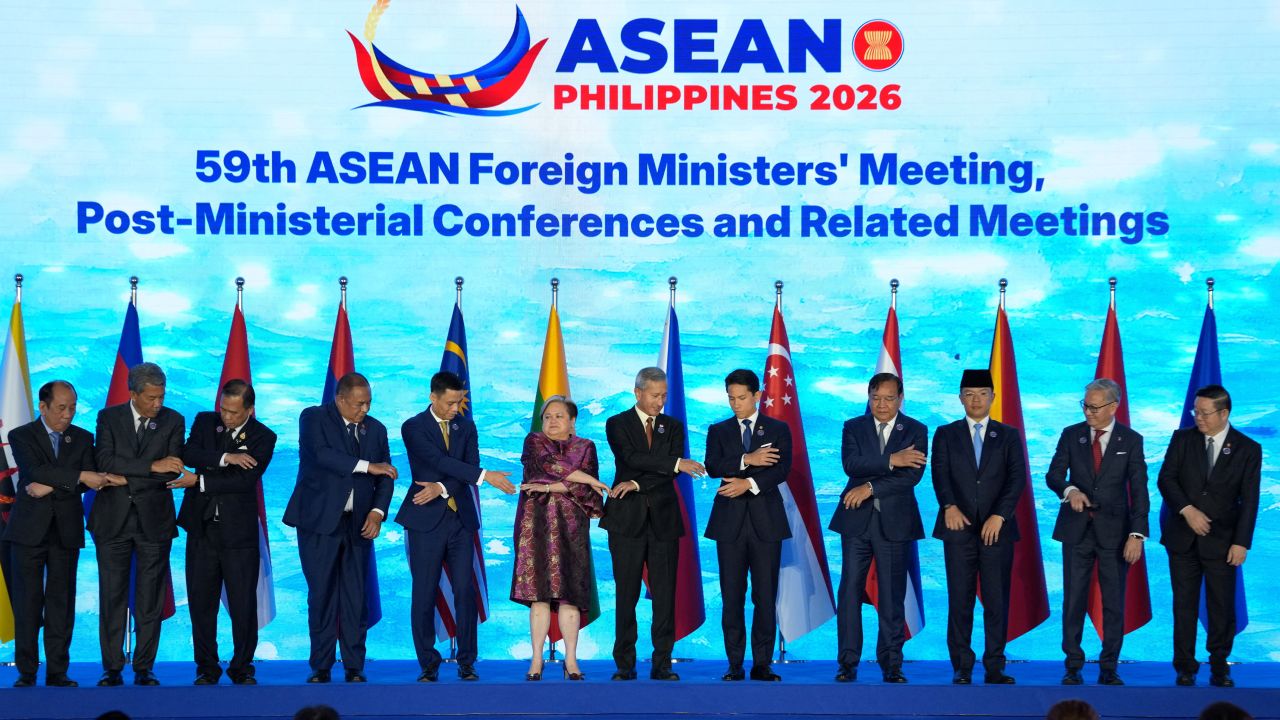
As ASEAN builds more durable maritime mechanisms, China continues to intensify pressure at sea. Japan must strengthen Philippine resilience while keeping its regional engagement compatible with ASEAN autonomy.
The most consequential developments surrounding the 59th ASEAN Foreign Ministers’ Meeting occurred beyond the conference rooms in Manila. While ASEAN ministers discussed international law, freedom of navigation and a South China Sea Code of Conduct, Chinese and Philippine personnel clashed at Second Thomas Shoal. Chinese coastguard vessels subsequently used water cannon against Philippine government vessels near Scarborough Shoal. The juxtaposition captured the emerging character of regional maritime politics: diplomacy is becoming more institutionalised, while coercion at sea is becoming more persistent. ASEAN’s agenda contained few genuinely new issues. Its significance lay instead in an effort to move from recurrent declarations towards negotiating procedures, maritime institutions and operational cooperation.
From Declarations to Maritime Institutions
The Code of Conduct negotiations provide the clearest example. The joint communiqué called for an effective and substantive agreement consistent with international law, including the United Nations Convention on the Law of the Sea, and set the objective of concluding negotiations within 2026. ASEAN also connected the negotiating process to confidence-building, preventive measures and practical steps designed to reduce accidents, misunderstandings and miscalculation. The shift from an open-ended appeal for early completion to a stated deadline creates political and procedural pressure. Yet the central problems remain embedded in the prospective agreement’s design: the geographical scope of application, legal force, dispute-settlement procedures, treatment of military activities by non-claimant states and consequences for violations. A document can be completed without producing an effective constraint on behaviour. The diplomatic achievement of the Philippine chairmanship therefore lies in procedural acceleration rather than a settled maritime order.
More durable change may be taking place outside the Code of Conduct process. ASEAN ministers endorsed the planned establishment of an ASEAN Maritime Centre in the Philippines to support technical cooperation, information sharing, research and capacity-building across ASEAN institutions. The communiqué also welcomed the completed concept paper and terms of reference for the ASEAN Coast Guard Forum and proposed its incorporation as a subsidiary body under the ASEAN Senior Officials’ Meeting. Joint training, search and rescue, marine-pollution response, humanitarian assistance and cooperation against transnational crime form the Forum’s initial remit. Such arrangements lack the visibility of a summit declaration, but they embed maritime cooperation within bureaucratic routines. Repeated contact among coastguards, maritime agencies and civilian officials can generate habits of coordination that formal diplomatic statements rarely produce.
Negotiating Rules while Reshaping Facts at Sea
Beijing’s conduct during the Manila meetings exposed the limits of the institutional approach. Chinese Foreign Minister Wang Yi told Philippine Foreign Secretary Maria Theresa Lazaro that bilateral relations stood at a ‘crossroads’ and called on Manila to make a ‘correct and rational’ choice. Wang also accused elements within the Philippine military and police of provoking incidents under instructions from external forces. The exchange followed a confrontation at Second Thomas Shoal in which Manila alleged that Chinese coastguard personnel struck a Philippine serviceman with a wooden baton; Beijing accused Philippine personnel of initiating the violence and ramming a Chinese vessel. Further confrontations near Scarborough Shoal involved water cannon, close manoeuvring and Chinese assertions that ‘control measures’ had been imposed on Philippine vessels.
China’s approach combines institutional participation with operational coercion. Beijing can negotiate a Code of Conduct, endorse confidence-building language and maintain diplomatic channels while preserving freedom of action for the China Coast Guard. Participation in regional negotiations limits reputational costs and prevents China from appearing openly opposed to ASEAN-led diplomacy. Continued pressure at sea changes the operational environment before any final rules acquire legal or political force. China is negotiating the rules while reshaping the conditions under which those rules will operate.
Can the Philippines Sustain the Contest?
The central question for Manila is one of endurance rather than resolve. The Philippines possesses the legal authority of the 2016 arbitral award, a defence treaty with the United States and expanding security partnerships with Japan, Australia and other maritime powers. Those advantages have increased diplomatic support and raised the visibility of Chinese actions. Material asymmetry remains pronounced, however. China can sustain larger coastguard deployments, rotate vessels more frequently and impose higher operating costs on Philippine resupply, patrol and fisheries-protection missions. Diplomatic legitimacy cannot repair ships, maintain surveillance coverage or keep crews at sea.
Philippine resilience will depend on maintenance capacity, logistics, communications, maritime-domain awareness, personnel rotation and policy continuity across changes of government. ASEAN mechanisms can reinforce Manila’s diplomatic legitimacy but cannot stop a water-cannon attack or maintain a resupply mission. Allied commitments can raise the cost of escalation but cannot substitute for Philippine operational capacity. The strategic test is cumulative: Beijing does not need to defeat the Philippines in a single confrontation when repeated low-level pressure can exhaust resources, strain institutions and expose political divisions.
ASEAN Draws the Line at the Taiwan Strait
The Manila communiqué demonstrated ASEAN’s continuing strategic restraint. The document reaffirmed navigational rights under UNCLOS, including transit passage through straits used for international navigation, and supported freedom of navigation and overflight in the South China Sea. The Taiwan Strait was not mentioned. Washington adopted a broader framing during the related meetings. US Secretary of State Marco Rubio warned that control over one international waterway could create precedents for coercion elsewhere, while American statements linked Chinese pressure in the South China Sea with coercive activity around Taiwan. ASEAN members have resisted that strategic integration. Most Southeast Asian governments prefer to keep the South China Sea, the Taiwan Strait and the East China Sea diplomatically distinct, even when American and Japanese strategy treats the three theatres as connected components of the same maritime balance.
Strategic restraint does not amount to indifference towards cross-Strait stability. Direct reference to Taiwan would force ASEAN members into disputes over sovereignty, recognition and alignment that could overwhelm the organisation’s limited consensus. General support for UNCLOS, navigational freedoms, peaceful dispute settlement and opposition to coercive changes in the maritime status quo offers a less explicit form of regional protection. Such principles do not create an ASEAN commitment to defend Taiwan. They reinforce a regional environment in which the unilateral restriction of international waterways carries a higher diplomatic cost.
Taiwan’s Opening Lies in Functional Cooperation
Taiwan should assess the Manila meetings through that institutional lens. An attempt to secure explicit ASEAN language on the Taiwan Strait would encounter the one-China policies of Southeast Asian states and strengthen Beijing’s claim that maritime cooperation is becoming an anti-China coalition. Taiwan has more promising avenues through search and rescue, fisheries governance, environmental protection, disaster response, maritime technology and coastguard professionalism. Functional participation can connect Taiwan to the emerging regional maritime architecture without demanding diplomatic recognition or a collective security declaration. The absence of Taiwan from the communiqué narrows formal political space, but it does not eliminate opportunities for practical maritime cooperation.
Taiwan’s policy objective should be to make itself useful to regional maritime governance. Cooperation in marine science, humanitarian assistance, fisheries management and emergency response can establish working relationships that survive political fluctuations. These forms of engagement will not deliver the symbolic recognition associated with formal communiqués, but they can strengthen the rules, capabilities and professional networks that sustain open waterways. For Taiwan, institutional access is more valuable than rhetorical inclusion that ASEAN members are unlikely to provide.
Japan’s Choice: Alliance Extension or Maritime Public Goods?
Japan occupies a more direct position in the emerging architecture. The Japan–Philippines Reciprocal Access Agreement entered into force in September 2025 and has already supported joint exercises. The Acquisition and Cross-Servicing Agreement signed in January 2026 establishes arrangements for reciprocal logistics and services between the Japan Self-Defence Forces and the Armed Forces of the Philippines. Japan has also used Official Security Assistance to fund boathouses and slipways for Philippine Navy rigid-hulled inflatable boats, while coastal radar systems supplied under an earlier OSA project have arrived in the Philippines. Bilateral cooperation now extends from classified military information and air-surveillance radars to discussions on transferring Abukuma-class destroyers and TC-90 aircraft. During Balikatan 2026, the Japan Self-Defence Forces conducted their first overseas live-fire exercise involving the Type 88 surface-to-ship missile.
Japanese support is developing from individual equipment transfers into an interconnected framework of access, training, logistics, surveillance, information protection and operational interoperability. Such a framework strengthens Philippine deterrence, but deterrence alone cannot supply a sustainable regional strategy. A policy centred on missiles, warships and alliance exercises would allow Beijing to portray Japan as extending a containment structure into Southeast Asia. Support for coastguard operations, vessel maintenance, communications, maritime-domain awareness, search and rescue and crisis-management procedures would produce a broader constituency within ASEAN. These capabilities protect sovereign rights while delivering maritime public goods.
Japan therefore needs a dual approach. Bilateral defence cooperation with Manila should raise the cost of coercion and improve the Philippines’ ability to remain present in contested waters. Regional engagement should reinforce ASEAN-led institutions that can attract participation from governments unwilling to join explicit balancing arrangements. The two tracks are complementary when Japanese assistance strengthens Philippine capacity and also improves the professional infrastructure of regional maritime governance. They diverge when every programme is presented as part of a unified front extending from the East China Sea through Taiwan to the South China Sea.
The Manila meetings revealed neither an ASEAN breakthrough nor diplomatic paralysis. Maritime competition is becoming institutionalised on several fronts. ASEAN is building procedures, coastguard networks and legal expectations. China is refining coastguard operations, administrative claims and calibrated coercion. Japan and the United States are constructing access, logistics and capacity-building arrangements around the Philippines. Taiwan is searching for functional entry points into a regional order that avoids explicit recognition of the island’s security role.
‘Mechanisms advance, strategy stays restrained’ captures ASEAN’s response to that environment. Institutional density is increasing without a corresponding movement towards a regional alliance. Japan’s influence will depend on whether Tokyo can work within that distinction. Effective Japanese policy should help the Philippines withstand sustained pressure, strengthen ASEAN’s maritime institutions and preserve the political space that allows Southeast Asian states to cooperate without formally choosing sides. The durability of the regional order will be determined less by the wording of the next communiqué than by which institutions can continue to operate when the next water-cannon incident occurs.
カテゴリー
最近の投稿
- Mechanisms Advance, Strategy Stays Restrained: ASEAN’s Manila Meeting and the Institutionalisation of South China Sea Competition
- 習近平はどう出るのか? イラン再攻撃をするトランプの背後でうごめいていた米軍の秘密戦略
- 中国のネットで沸く高市X投稿「風呂掃除、洗濯、裁縫、アイロンかけ…」
- トランプ大統領令「国防企業への中国の影響力排除」はG2構想を崩すか?
- 高市内閣支持率41% 中国は支持率下落をどう見ているか?
- トランプ演説の「中国の2020米大統領選介入」対中批判はG2構想を崩壊させるのか?
- GDPでは測れない中国の新産業(ハイテク製造業)生産力
- 中国の民族団結法と、国外に広がる法的威圧の影
- 日本に憧れた中国動漫新人類は今どこに?アジア最大級イベント「ビリビリワールド」が席巻する中国発ゲーム
- 記念日
RSS