

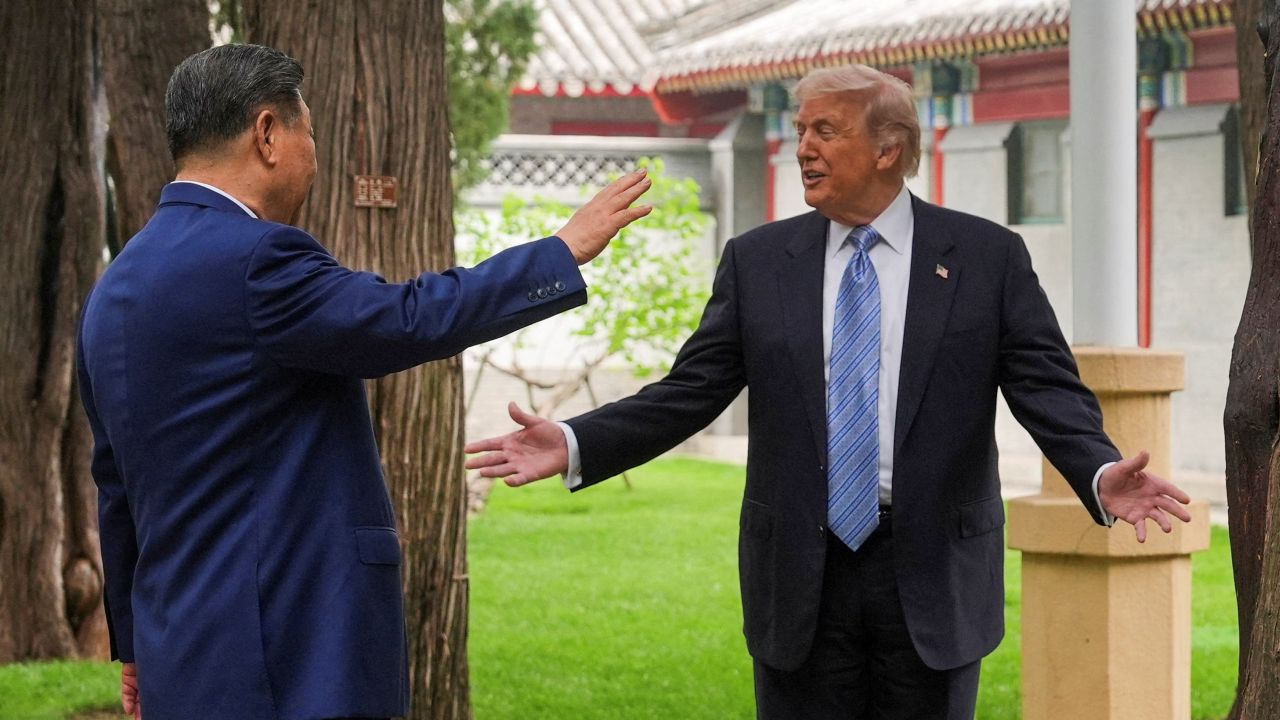
Xi Jinping’s visit may ease immediate tensions without altering the structural competition between Washington and Beijing. For Japan and Taiwan, the more important question is how far US–China bargaining can extend before it begins to affect alliance commitments, economic security and regional deterrence.
Xi Jinping’s expected visit to the United States around 24 September will again invite speculation about whether Washington and Beijing are entering a period of improved relations. A more useful reading is that the two governments are trying to restore a degree of manageability to a relationship in which strategic competition has become increasingly difficult to contain.
When Donald Trump visited Beijing in May, he described Xi’s planned return visit in explicitly reciprocal terms. Reciprocal presidential visits restore a measure of diplomatic regularity and give both leaders a direct channel for dealing with disputes before they become harder to control. They do not, however, alter the underlying sources of competition. Semiconductors, artificial intelligence, critical technologies, supply-chain security and regional influence remain central areas of rivalry.
The value of leader-level diplomacy lies in determining where bargaining is still possible. Some economic disputes can be adjusted through negotiation; others have become tied closely to national-security policy and are much harder to reopen. The relationship now combines strategic rivalry with selective bargaining, producing a pattern closer to managed competition than either reconciliation or unrestricted confrontation.
Trump Needs a Visible Political Gain
The timing of the summit gives Trump strong domestic incentives to seek tangible results. The US midterm elections will be held on 3 November, only several weeks after the expected meeting, and any agreement with Xi will quickly become part of the domestic political debate.
Large Chinese purchases of American agricultural products, new investment commitments, wider market access or selected tariff concessions would give Trump outcomes that can be presented directly to voters. Their political value rises when they can be linked to exports, investment, employment or market confidence, particularly in sectors and regions where economic concerns carry electoral weight.
Trump has long treated high-level diplomacy as a venue for demonstrating personal bargaining effectiveness. A substantial agreement with Xi would allow him to claim that direct negotiation produced gains that conventional diplomacy had failed to secure. Beijing has every reason to recognise this incentive. Economic concessions that offer Trump a visible success at home may also give China greater room to seek flexibility from Washington elsewhere.
Diplomatic symbolism alone is therefore unlikely to satisfy Trump. The political value of the summit will depend heavily on whether it produces outcomes that can be identified, measured and attributed to his own intervention.
Xi Wants Predictability
Xi enters the summit with a different set of priorities. Beijing’s immediate concern is to limit uncertainty across several fronts at once, including tariffs, technology controls, critical minerals and security competition. Simultaneous escalation would complicate both domestic economic management and longer-term industrial policy.
Greater predictability would allow Beijing to distinguish between areas where US pressure is likely to intensify and those where negotiated adjustment remains possible. Such clarity matters even if the broader strategic rivalry continues.
Reciprocal summit diplomacy also serves China’s preferred image of major-power relations. Direct engagement between Xi and Trump reinforces Beijing’s claim that the two countries should deal with each other at the highest political level despite their differences.
The contrast between the two leaders may create room for agreement. Trump has strong incentives to secure results with immediate political value, while Xi has stronger reasons to prevent economic and technological pressure from expanding simultaneously. Their objectives differ, but they can intersect through a bargain in which visible economic concessions are exchanged for greater policy stability.
Transactional Gains Are Not Structural Change
Economic issues remain the most promising area for summit outcomes. Agricultural purchases, energy contracts, investment commitments, market-access measures and selected tariff reductions can all be adjusted without forcing either government to revise its broader strategic position.
Their significance should nevertheless be kept in proportion. Additional Chinese purchases of US soybeans would improve the commercial atmosphere without changing the technological rivalry. Tariff reductions in selected sectors would leave semiconductor restrictions intact, while new investment agreements would do little to resolve disputes over artificial intelligence, export controls or supply-chain security.
Different parts of the bilateral relationship now follow different policy logics. Trade and investment may remain open to bargaining even as advanced technology becomes more tightly governed by security considerations. The post-summit picture will depend on which issues return to negotiation and which remain protected from transactional adjustment.
This uneven pattern is likely to persist. Economic accommodation can coexist with technology controls, just as dialogue on selected global issues can proceed alongside competition over strategic industries.
Japan Has Much at Stake in Managed Competition
Japan has no interest in uncontrolled confrontation between its principal security ally and its largest trading partner. A more predictable US–China relationship could lower the risk of sudden regional escalation and provide a more stable environment for trade and investment.
Tokyo’s concern centres on the terms of that stability. Japan relies heavily on the credibility of the US alliance while facing growing Chinese military activity in the East China Sea and a more demanding regional security environment. Developments across the Taiwan Strait are also increasingly relevant to Japanese defence planning and regional risk assessments.
A less confrontational US–China relationship could therefore serve Japanese interests, provided that bilateral accommodation does not weaken deterrence or introduce greater uncertainty into US security commitments. Tokyo will be attentive to any changes that affect the East China Sea, Taiwan Strait or the wider balance between US reassurance and engagement with Beijing.
Economic security creates a parallel concern. Japan has invested heavily in semiconductor supply-chain resilience, critical-mineral diversification and efforts to reduce excessive exposure to China. Yet Japanese industry remains deeply connected to Chinese markets, processing capacity and strategic inputs. A selective US–China economic accommodation could ease pressure on trade and business confidence while simultaneously changing the regulatory environment in which Japan has been restructuring its own economic-security policies.
Changes in US technology controls, critical-mineral arrangements or investment restrictions would therefore matter well beyond the bilateral relationship. Tokyo will also want to know whether Washington continues to coordinate major China-policy adjustments with its allies.
For Japan, uncertainty in American policy can be almost as consequential as uncertainty in Chinese behaviour.
Taiwan Faces a Different Boundary Problem
Taiwan faces the same bargaining environment from a more exposed strategic position. Taipei’s concern extends beyond whether Taiwan is mentioned in a summit statement or raised directly in the leaders’ discussions. The more consequential issue is the degree of flexibility Washington retains across different areas of China policy.
Beijing enters the summit knowing that Trump has unusually strong incentives to produce an economic success before the midterms. Large agricultural purchases, investment commitments or market-access concessions could therefore carry political value beyond their commercial importance. Taipei will be watching closely for the kind of response Washington considers appropriate.
Tariffs and commercial restrictions offer considerable room for presidential adjustment. Some technology controls may also be modified at the margins. Security policy is more institutionally constrained because US policy towards Taiwan is shaped by Congress, the defence establishment, the bureaucracy and a broader strategic assessment of China.
These constraints reduce the scope for dramatic change but do not eliminate the effects of transactional diplomacy. Policy can still move through changes in language, sequencing and priority. Decisions may be delayed, restrictions modified, or contentious issues temporarily set aside in order to preserve a broader agreement with Beijing.
The more realistic concern is therefore incremental adjustment rather than a sudden grand bargain. Leader-level diplomacy matters most when it changes the relative weight given to different policy objectives without formally overturning existing commitments.
Taiwan’s task is to distinguish between areas where presidential discretion remains substantial and those where US policy has become more deeply institutionalised.
The Boundaries Matter More Than the Atmosphere
The September summit will be more revealing in its substantive exchanges than in its public choreography. US–China relations are unlikely to return to the broad engagement of earlier decades, yet sustained confrontation across every issue would be costly for both governments. Selective transactions are therefore likely to coexist with long-term strategic competition.
For Trump, such an arrangement creates opportunities to convert foreign-policy deals into domestic political gains before the midterms. For Xi, it can provide greater clarity about the direction of US policy and reduce the risk of simultaneous pressure across economic and technological fronts.
Japan and Taiwan approach this emerging order from different positions. Japan must assess whether bilateral accommodation remains compatible with alliance reassurance and coordinated economic-security policy. Taiwan must judge which elements of US policy are deeply anchored and which remain open to adjustment within a broader negotiation with Beijing.
A successful summit could reduce tensions and generate real economic benefits for the region. The larger question is how far that bargaining extends. For Japan and Taiwan, the durability of regional stability will depend less on the warmth of Trump–Xi diplomacy than on whether selective deals with Beijing remain bounded by credible long-term US security commitments.
カテゴリー
最近の投稿
- 中国代表団の日本領土・北方四島訪問と迫りくる「米中露戦後秩序の構図」 トランプが「米中露首脳会談」提案
- フライング・タイガースに端を発する東アジアの歴史認識を巡る争い
- トランプが中露に石油精製製品の増産・供給を要請した結果、習近平の「米中露戦後秩序の構図」を強化か?
- 岩屋氏の中国に対する「日中共同声明の再確認提案」は無駄 習近平が何を狙っているのかをわかっていない
- 共産主義者を追い出す
- 習近平の「米中露戦後秩序の構図」は、日本を「新型軍国主義」と指摘することによって何を狙っているのか?
- The Flying Tigers and the Battle over Wartime Memory in East Asia
- WWⅡの同盟国・米中の敵国は日本 そこに潜む中国の恐るべき「新型軍国主義・日本とG2」構図
- Casting out the communists
- トランプ「中国は同盟国」発言は事前に習近平と調整 梯子を外された高市首相
RSS